


Waharoa, a deeply valued and admired artwork by celebrated artist the late Selwyn Muru (Te Aupōuri, Ngāti Kurī, Ngāti Muri Kahara, Ngāti Rehia, Te Whakatōhea) has been carefully restored by Auckland Council’s Public Art team.
Originally created in 1990 and positioned at the entrance to Te Pokapū (Aotea Centre), Waharoa is now revitalised and refreshed.
Bringing te ao Māori expression to the city centre, Muru’s restored seven-metre gateway welcomes Aucklanders and visitors into the square at the Queen Street entry. The iconic artwork has become an important place where people gather and meet.
Once described as one of the most original Māori thinkers of his time, Selwyn Muru previously said of this work: "The aim of this waharoa (gateway) is to welcome and embrace manuhiri (visitors) to Aotea Square. I chose wood as a medium because it already has mauri (life force) of its own and would exude warmth in an environment dominated by steel, glass and stone."
Deputy Mayor Desley Simpson says the restoration of Waharoa is a moment of real pride for our city.
“Selwyn Muru’s work has welcomed generations of Aucklanders and visitors into Aotea Square - and I can’t wait to see them snapping photos under this iconic piece of art once more. It’s part of Auckland’s identity and restoring it ensures Muru’s legacy continues to stand at the heart of our civic and cultural life,” she says.
Head of Arts and Culture Emily Trent is delighted this treasured taonga, by one of New Zealand’s leading Māori artists, has been carefully restored to its best condition and can be enjoyed by Aucklanders and visitors to Aotea Square for years to come.
"Public art shapes how people experience, move through and identify with our city. It signals that these places are alive, loved, and looked after. When public art is cared for, it sends a clear message: this place matters to us and we’re committed to looking after it.”
“It is also good asset management. These works are exposed to weather, so the council’s commitment to good maintenance practice helps keep them from needing more complex work later,” she says.
About Waharoa
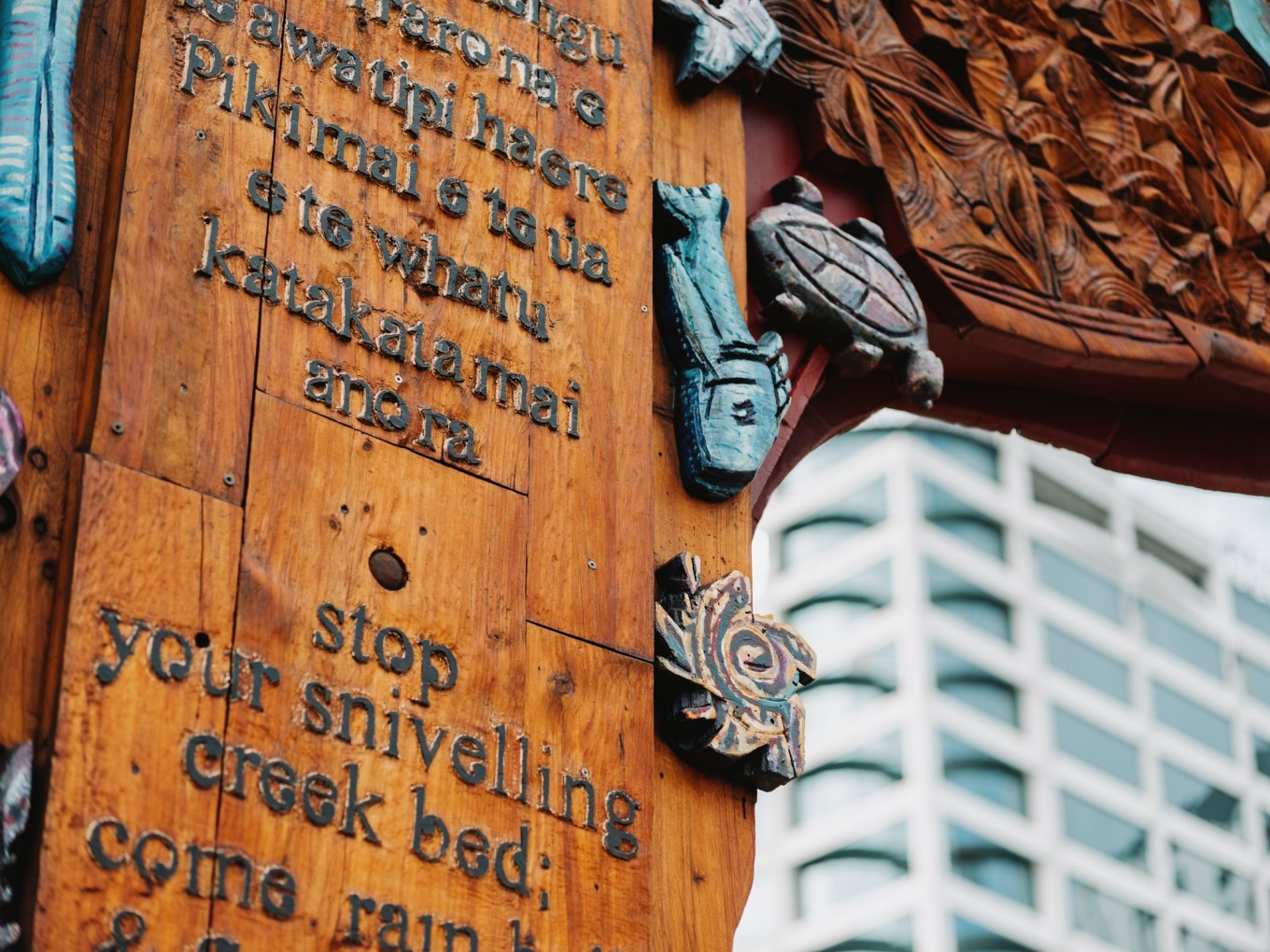
‘Haiku’ by Hone Tuwhare on the Waharoa, with Māori translation by Selwyn Muru. Photo credit: David St George.
The sculpture brings together environmental, cultural, and cosmological themes through dynamic carved forms, painting, and copper detailing. Some copper was salvaged from the tops of the old Waitangi Wharf piles, while newer copper was treated with vinegar and left to age.
At the top of the gateway are five carvings of Māori atua (deities): Tama-nui-te-rā (the sun), Tangaroa (the sea), shown in whale form, and Tāne Mahuta (the forest), depicted as a bird. Beside Tāne is Tāwhirimātea (the weather). On the far left is Whetū me te Marama, representing the stars and crescent moon of the upper realms.
The work reflects the cultural richness and diversity of life in Auckland. The sculpture also includes contemporary motifs. These include a nuclear disarmament symbol (peace), a cross, and a heart pierced by an arrow. The arts are also represented, with references to storytelling, literature, dance, poetry, and performance, including icons of a ballerina, a guitar, and a saxophone. These elements relate to the nearby Aotea Centre and Auckland’s central arts precinct.
Patterns and icons throughout the work draw on the Pacific setting, with recurring forms of birds, fish, turtles, and whales. These elements reflect Auckland’s location within the Pacific and the diverse origins of its people, shaped by movement across the region and beyond.
Connections to two of Muru’s close friends and fellow artists are included. A haiku by the late Māori poet Hone Tuwhare is inscribed into the work, with a te reo Māori translation by Muru. The poem refers to Te Waihorotiu stream, which once flowed down the Queen Street valley and is now piped underground. A carving of a dog is based on a pet belonging to Paratene Matchitt. One of Matchitt’s works is located nearby in the Aotea Centre.
About the artist: Selwyn Muru
Herewini Murupaenga, known as Selwyn Muru, was born in Te Hāpua, Northland, in 1937. A visual artist, broadcaster, playwright, social commentator, actor, professional musician, orator, teacher, and tribal bearer of knowledge, he built a pioneering legacy and leadership across multiple fields of activity.
He passed away in January 2024.
More about this artwork at Auckland Council Public Art, Auckland Live and Public Art NZ.
About Aotea Square
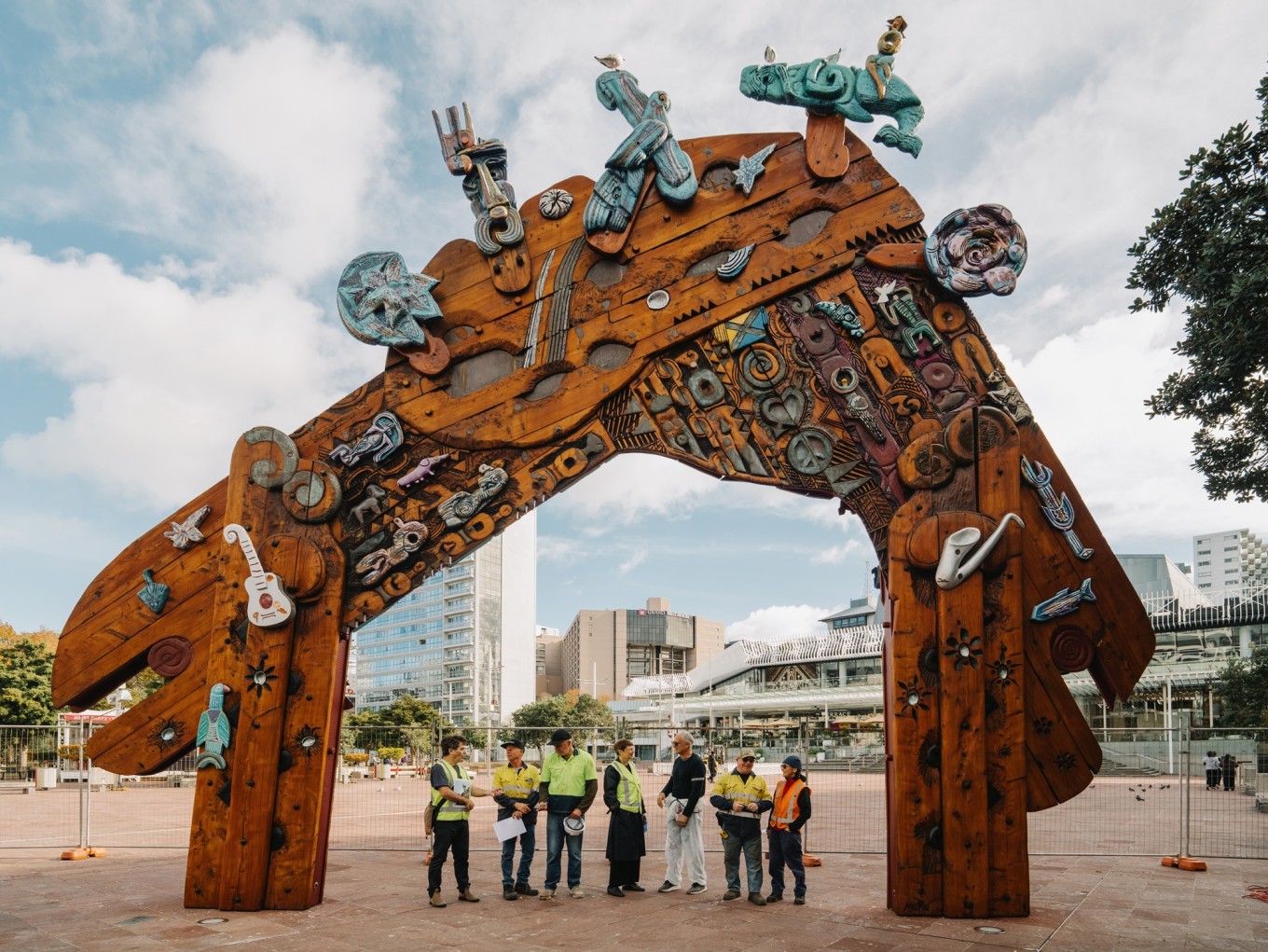
Artist whanau and Public Art Team with restored Waharoa by Selwyn Muru. Photo credit: David St George.
Aotea Square hosts a wide range of major festivals and civic events throughout the year, including flagship programmes such as the annual Auckland Arts Festival, BNZ Diwali Festival, Summer in the Square supported by Auckland Council Events, alongside community gatherings, seasonal activations and public events. These are often multi-day events, comprising multiple performances, markets, screenings and live experiences, and collectively make the square one of the city’s most active and visible public event spaces.