


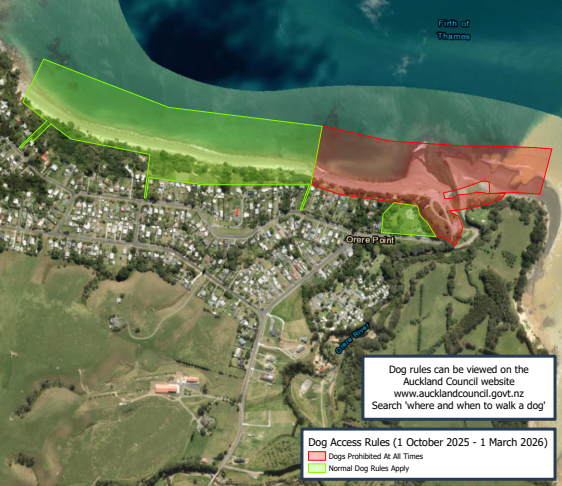
To protect our native shorebirds, like the endangered dotterel, during breeding season, there’ll be temporary changes to dog access rules at Ōrere Point Beach Reserve and Ōrere Beach this spring/summer.
From 1 October 2025 until 1 March 2026, dogs will be prohibited at all times on beach and intertidal areas within Ōrere Point Beach Reserve car park and east of the Ōrere River mouth.
Safeguarding our shorebirds
The Auckland region is a hotspot for shorebirds including the endangered New Zealand dotterel, Caspian tern, variable oystercatcher, white-fronted tern and South Island pied oystercatcher.
These bird species are native to New Zealand and are formally classified as Threatened or At Risk at the national level by the Department of Conservation, and at the regional level by Auckland Council.
“In 2024/2025 breeding season, three pairs of northern New Zealand dotterels attempted to nest east of the Ōrere River mouth, with only one chick successfully fledging. Nesting birds and chicks are very vulnerable to disturbance and predation by mammals, including dogs until the chicks fledge at around six weeks old,” says Maddie White, Auckland Council Conservation Advisor.
Reef heron (Regionally Critical) have also been observed foraging in the intertidal zone at low tide. Reef heron are wary and will fly away when approached too closely. This means that they are particularly vulnerable to disturbance by people and dogs.
Breeding and roosting habitat for shorebirds is of very limited extent around Auckland, and much of it is under pressure from development and recreational activities – this includes dog walking.
Dotterel nests and chicks are easy to miss and can be accidentally crushed by walkers and disturbed by dogs. Prolonging the time that adult birds spend off the nest can cause egg temperature fluctuations, which may result in egg mortality, and increases the risk of predation. We know that dogs can also harass or prey on young birds, which are flightless for the first 6-7 weeks of life.
Research shows that shorebirds perceive dogs (even on-leash) as a greater threat than just humans. This is why they need protection, explains Ms White.
“We know Aucklanders love and care for our natural environment and our native wildlife so we’re asking dog owners to follow all signs and instructions during the breeding season and help protect these precious shorebirds,” she says.
“At-risk bird populations have the best chance for young birds to hatch and thrive if beach users limit their own access around nesting areas during the breeding season.”
Under the Auckland Council’s Dog Management Bylaw 2019, the council can impose temporary dog bans in places where ‘threatened’ or ‘at risk’ protected wildlife vulnerable to dogs is present.
There are plenty of great places to walk your dog in Auckland. You can check them out on the Auckland Council website.