


On 7 January 2026, a single male Queensland fruit fly (Bactrocera tryoni) was found in a backyard surveillance trap in the suburb of Mt Roskill in Auckland.
Biosecurity New Zealand, part of the Ministry for Primary Industries (MPI), has mounted an operation to determine if there are more fruit flies and get rid of any population in the area.
Its operation includes field teams in the area and planning for trapping, inspections and, as a precautionary measure, restrictions on the movement of fruit and vegetables in the area.
The capture of a single male does not mean we have an outbreak. However, while Biosecurity New Zealand undertake checks for any other fruit flies, they need community help to prevent any possible spread.
Visit Biosecurity New Zealand’s website for the most up to date information on this response.
Changes to your kerbside collections
This area is divided into two zones, A and B, which have different restrictions. To check if you are in the controlled area and which zone applies to you visit Biosecurity New Zealand’s website.
These restrictions mean some changes to kerbside (particularly food scraps) collections in the area.
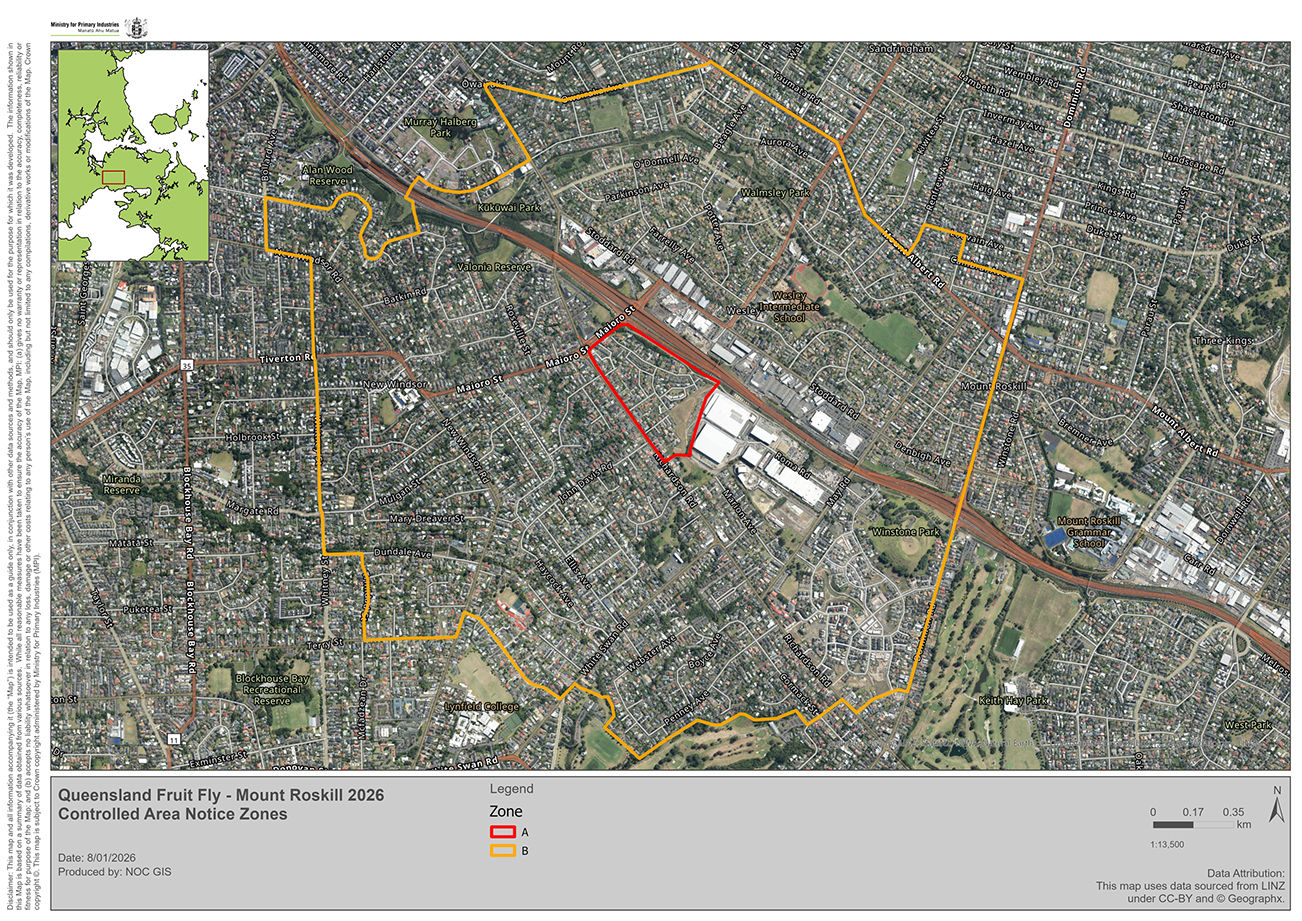
Queensland fruit fly - Mt Roskill 2026: Controlled Area Notice zones. Source: Biosecurity New Zealand
Auckland Council waste collections in Zone A
- There will be no food scraps collections (the small 23L bin) in this area until further notice.
- Follow Biosecurity New Zealand’s instructions to dispose of your fruit and vegetable waste.
- All other food waste e.g. meat, cooked meal scraps, dairy products, rice and pasta etc, should also go into your MPI bin.
- Rubbish and recycling collections will continue as usual.
- Do not put food waste into your recycling bins or rubbish bins.
Zone A general restrictions (source: Biosecurity New Zealand)
- No fruit and vegetables (other than leafy or soil free root vegetables and cooked, processed, preserved, dried, frozen and canned fruit) can be moved from Zone A of the controlled area.
- Compost and green waste from gardens also cannot be moved out of this zone.
- Residents in Zone A are asked to avoid composting fruit and vegetables.
- To dispose of fruit and vegetable waste, use a sink waste disposal unit if available, or bins provided by Biosecurity New Zealand. These bins will be delivered shortly, and residents advised of their location.
Auckland Council waste collections in Zone B
- No fruit and vegetables grown in the Zone B can be moved out of the controlled area.
- You are free to move commercially purchased fruit and vegetables (e.g. fruit and vegetables brought at the supermarket) out of the area.
- Rubbish, recycling and food scraps collections continue as normal however all homegrown produce waste and garden waste needs to be disposed of in Biosecurity New Zealand bins.
Remember: If in doubt, don't take it out
What else you can do
It requires a big effort from all of us to keep these fruit flies out. If you think you’ve found this fruit fly or seen what look like its maggots in fruit:
- photograph it
- capture it (if you can)
- call MPI’s Pest and Diseases Hotline on 0800 809 966
About this fruit fly
In its native home, the Queensland fruit fly costs growers hundreds of millions of dollars a year in damage and pest control.
It has spread from Queensland to other parts of Australia, New Caledonia, French Polynesia, and the Pitcairn Islands.
The adult fly lays its eggs in fruit. When the maggots hatch, they eat the fruit, causing it to rot.
The maggots eat more than 200 different types of fruit and vegetables. Their favourite hosts are guava, stone fruit, tomatoes, and mango.
Adult flies:
- are 6mm to 8 mm long (a little larger than a house fly)
- are reddish-brown with distinct yellow markings
- have clear wings.
The female fly has a pointed 'sting' (its ovipositor) at the end of her body.