


Update: 2 March 2026, 7pm
Today, Biosecurity New Zealand has informed us that it is widening its trapping zone in Papatoetoe after today finding three more male Oriental fruit flies. Today’s detections mean the restrictions on movement of fruit and vegetables have been extended.
There are now three areas under Zone A restrictions, approximately 200-metres around each fly detection. Zone B has also been extended to account for the location of the new detections.
A detailed map of the controlled area and a full description of the new boundaries and movement controls is at mpi.govt.nz/fruitfly and in the article below.
------------------------------------------------------
On 25 February 2026, Biosecurity New Zealand (MPI) announced the discovery of a single male Oriental fruit fly (Bactrocera dorsalis) in a surveillance trap in Papatoetoe.
In response, Biosecurity New Zealand has launched a biosecurity operation and is ramping up trapping and inspections in Papatoetoe. As a precautionary measure, legal restrictions on the movement of fruit and vegetables out of the area where the fruit fly has been found (a Controlled Area Notice or CAN) will be put in place.
It is important to know that the capture of a single male does not mean we have an outbreak. It does mean that the community needs to keep an eye out and report any sightings.
Biosecurity New Zealand has successfully eradicated 15 incursions of different fruit fly in Auckland and Northland – including a recent response in Mt Roskill to eradicate a Queensland fruit fly (unrelated to this find).
The fruit fly poses no human health risk, but there would be an economic cost to the horticulture industry if it were allowed to establish here.
Visit Biosecurity New Zealand’s website for the most up to date information on this response.
Changes to your kerbside collections
The affected area in Papatoetoe is divided into two zones, A and B, which have different restrictions. To check if you are in the controlled area and which zone applies to you visit Biosecurity New Zealand’s website.
These restrictions mean some changes to kerbside (particularly food scraps) collections in the area.
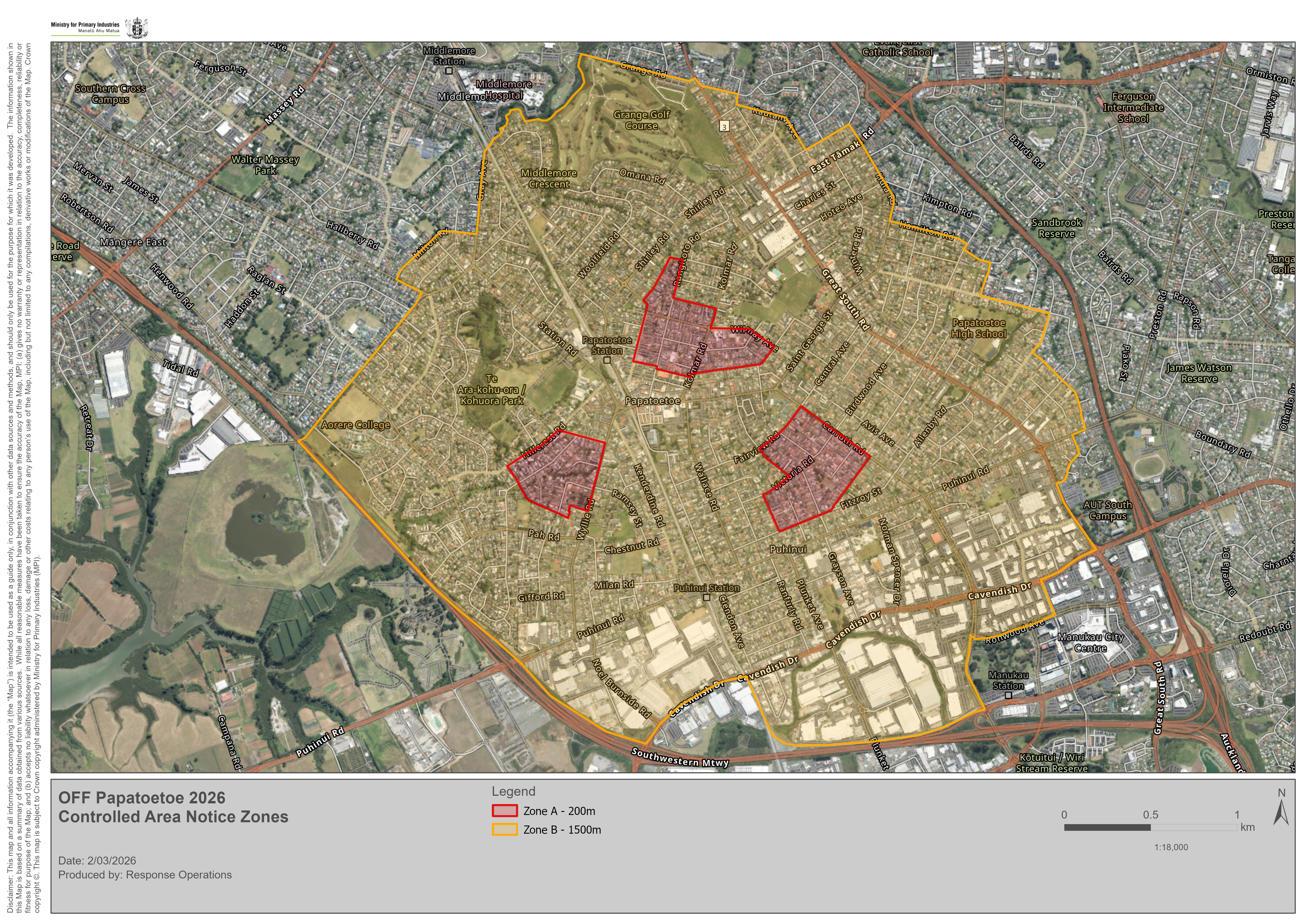
Oriental fruit fly - Papatoetoe 2026: updated Controlled Area Notice zones. Source: Biosecurity New Zealand
Auckland Council waste collections in Zone A
- There will be no food scraps collections (the small 23L bin) in this area until further notice due to the Controlled Area Notice.
- Follow Biosecurity New Zealand’s instructions to dispose of your fruit and vegetable waste.
- All other food waste, such as meat, cooked meal scraps, dairy products, rice and pasta etc, should also go into your MPI bin.
- Rubbish and recycling collections will continue as usual.
- Do not put food waste into your recycling bins or rubbish bins.
- Zone A general restrictions (source: Biosecurity New Zealand)
- No fruit and vegetables (other than leafy or soil free root vegetables and cooked, processed, preserved, dried, frozen and canned fruit) can be moved from Zone A of the controlled area.
- Compost and green waste from gardens also cannot be moved out of this zone.
- Residents in Zone A are asked to avoid composting fruit and vegetables.
- To dispose of fruit and vegetable waste, use a sink waste disposal unit if available, or bins provided by Biosecurity New Zealand. These bins will be delivered shortly, and residents advised of their location.
Auckland Council waste collections in Zone B
- No fruit and vegetables grown in Zone B can be moved out of the controlled area.
- You are free to move commercially purchased fruit and vegetables (e.g. fruit and vegetables brought at the supermarket) out of the area.
- Rubbish, recycling and food scraps collections continue as normal however all homegrown produce waste and garden waste needs to be disposed of in Biosecurity New Zealand bins.
Remember: If in doubt, don't take it out
What else you can do
It requires a big effort from all of us to keep these fruit flies out. If you think you’ve found this fruit fly or seen what look like its maggots in fruit:
- photograph it
- capture it (if you can)
- call MPI’s Pest and Diseases Hotline on 0800 809 966
About this fruit fly
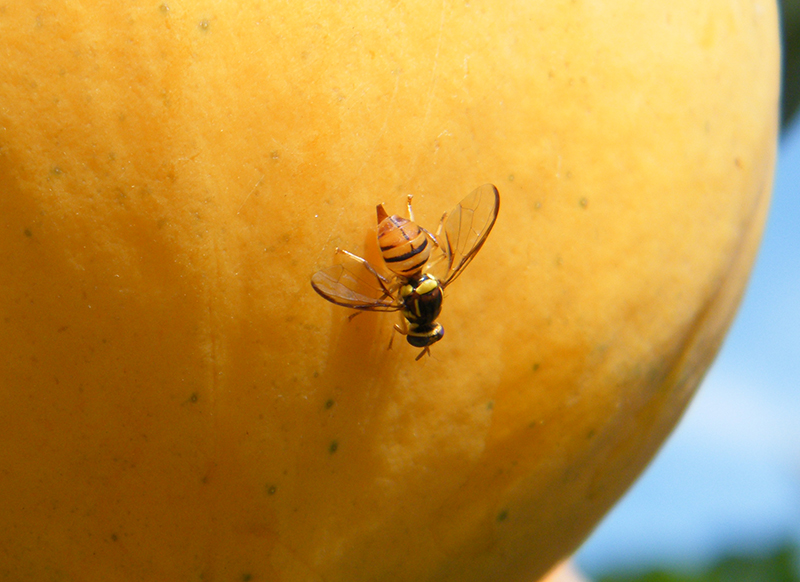
Oriental fruit fly on a fruit. Source: Biosecurity New Zealand.
The Oriental fruit fly is native to Asia but has now spread to many warmer countries, especially as the climate warms. Adult flies lay eggs into fruit, and the young stages (maggots) feed inside the fruit, causing it to rot and become unmarketable.
The Oriental fruit fly maggots can feed on 300 different fruit and vegetables – the fly's favourite hosts are apple, guava, mango, peach, and pear.
Adult flies:
- are a little larger than a housefly (6mm to 8mm long)
- have a dark "T" shaped marking on the abdomen (the part behind the waist)
- usually have a bright yellow and orange abdomen (but can vary)
- have clear wings.
The female fly has a pointed “sting” to lay eggs inside fruit (but she can't sting or bite people). The male fruit fly is a similar size but is reddish-brown.