


Sir Barry Curtis, the former Mayor of Manukau who devoted nearly 40 years of his life to serving the people of Manukau and Auckland has passed away.
Sir Barry was a dedicated public servant, known for his remarkable 24-year tenure as the third Mayor of Manukau, a role he held from 1983 until his retirement in 2007 and for his long and distinguished career of public service.
“I knew Sir Barry well,” says Mayor Wayne Brown. “He was a hugely influential figure in local politics and a pioneer as Mayor of Manukau City Council for 24 years. He was the country’s longest serving mayor at the time.
“Sir Barry oversaw the foundation of what became Manukau city and his legacy is visible with the growth that followed in Manukau, community facilities and parks.
“He was known for his booming trademark voice and was a genuine champion of the communities he served over a 40-year career in local government. He leaves an enormous legacy,” says Mayor Brown.
Councillor Alf Filipaina, who served alongside Sir Barry for two terms on the Manukau City Council, gave a heartfelt tribute to his dear friend and colleague.
“My history with Sir Barry goes back many years to when I first served as a police officer in 1978. I came to know him even more closely when I was elected to the Manukau City Council in 2003.
“One of the first jobs he gave me in 2004 was the chair of the Transport Committee. That man meant so much to me, he brought Manukau City Council and our community together.
"He was a leader with mana and someone you trusted because he had the respect of the whole community, not only in Manukau and Tāmaki Makaurau but also across Aotearoa.
“Sir Barry championed an approach dubbed the "Manukau Way," which balanced economic progress with community welfare and fostered inclusive partnerships, particularly with iwi through early engagement on issues like the Manukau Harbour claim and Treaty of Waitangi responsibilities.
“From my perspective, part of his legacy will be about uniting diverse communities and ensuring that Manukau plays a significant contribution to Auckland’s economic, social, and cultural advancement,” says Cr Filipaina.
Auckland Council Chief Executive Phil Wilson says Sir Barry leaves a legacy of leadership, community service and unwavering commitment to the people of South Auckland.
“His leadership fostered a sense of belonging and pride across generations, with a particular focus on creating pathways and opportunities for young people to thrive.
“I will particularly remember him for his very astute political leadership; his acerbic wit; and his very deep commitment to Manukau and its diverse communities,” says Phil.
The creation of Barry Curtis Park in Flat Bush, Auckland’s largest urban park (94ha) in 100 years, stands as a testament to his impact on the community.
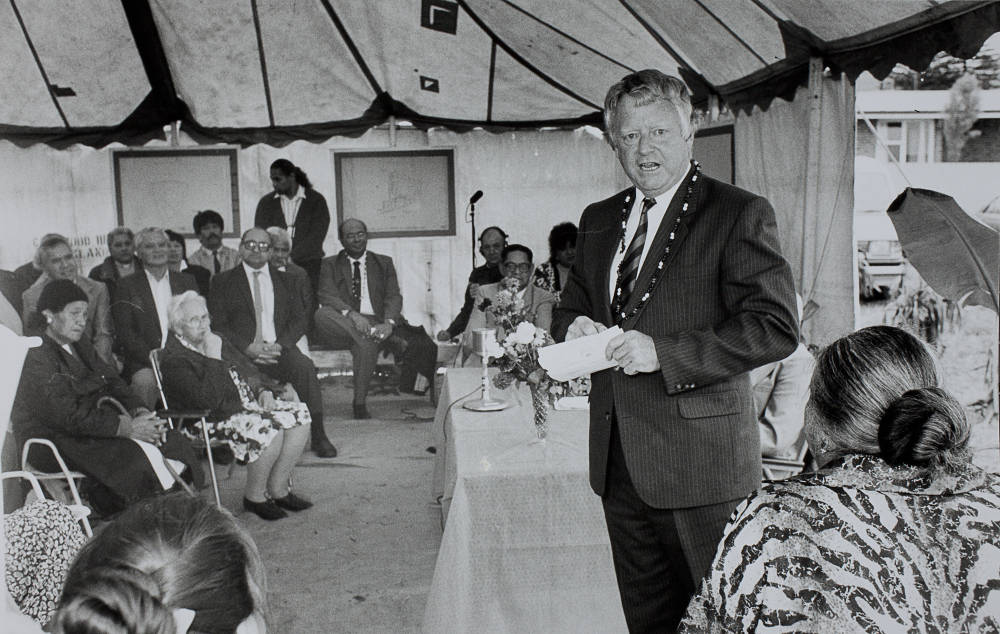
Manukau Mayor Sir Barry Curtis addresses members and supporters of the Takitimu Cultural and Arts Society during a ceremony to bless the site of a planned Cook Islands marae in Tanners Road, Māngere. (Auckland Libraries Heritage Collections Footprints 03495).
40 years of public life
Sir Barry first entered public life in 1968 as a councillor, just three years after the city of Manukau was formed. In 1971, he was also elected as a member of the Auckland Regional Authority and was re-elected four times, acting as chair of the Authority’s regional planning committee for six years.
His election as Mayor of Manukau in 1983 marked the beginning of eight consecutive terms in office, during which he championed community development, cultural inclusivity, and forward-thinking urban planning. At the time of his retirement from public life in 2007 after 39 years of continuous public service he was New Zealand's longest-serving mayor.
Sir Barry spent most of his life in Manukau living in Bucklands Beach, where he also spent his childhood, before moving to the suburb of Eastern Beach following his retirement. He was educated at Otahuhu College and later obtained a Diploma of Town Planning from the University of Auckland. He embarked on a career as a surveyor and town planner before establishing his own planning, surveying, and architecture firm, later becoming a town planning consultant.
He had a strong belief in social equity, and he once remarked that one of his guiding passions was social justice and promoting opportunity for all, no matter what their social background.
“I came from a poor family and my father was a waterside worker. That is why I know how it feels to be born on the wrong side of the tracks. I never forget that,” Sir Barry reflected at the time of his retirement.
"I have worked hard to make Manukau the place it is today and creating the infrastructure and quality public services that the community expects has been vitally important to me."
Knighted in 1992 for his services to local government and the community, Sir Barry was also awarded the Samoan Matai title of Seiuli by His Highness Malietoa Tanumafili II in 1994, in recognition of his outstanding contributions to the welfare and cultural interests of Manukau’s Samoan and Pacific Island communities.
Sir Barry's influence extended beyond local government, serving in national roles such as Chairman of the Hillary Commission’s Task Force on Recreation and Director of the 1990 Commonwealth Games. He was also a patron of numerous community organisations.