


Hobsonville Point has evolved into a living example of smart housing in a growing city.
The harbourside suburb in west Auckland has shown how walkable, well-designed, mixed density housing can build a strong sense of community.
Like Northcote ( and many other emerging suburbs offering medium density housing options built close to transport hubs, town centres, schools and community facilities) Hobsonville Point is a housing blueprint envisioned and enabled by the Auckland Unitary Plan.
Hobsonville Point, now a flourishing residential suburb, has grown up from land once used as an airforce base. When the land became available, it was essentially a blank slate for new housing and presented an opportunity to do things smarter and more sustainably.
The Auckland Council group worked closely with the Hobsonville Land Company (a subsidiary of Housing New Zealand established to lead the development, and now part of Kāinga Ora – Homes and Communities) and private sector partners to deliver a new kind of neighbourhood for Tāmaki Makaurau Auckland.
Ten years later, Hobsonville Point is a model of effective master-planning and the delivery of mixed density housing at scale. It is a model for the future.
Hobsonville Point resident and business owner Mike (Buzz) Thomson was sceptical at first of the ‘moments away, worlds apart’ slogan, but after living here since 2017 he believes it delivers more than the slogans promise.
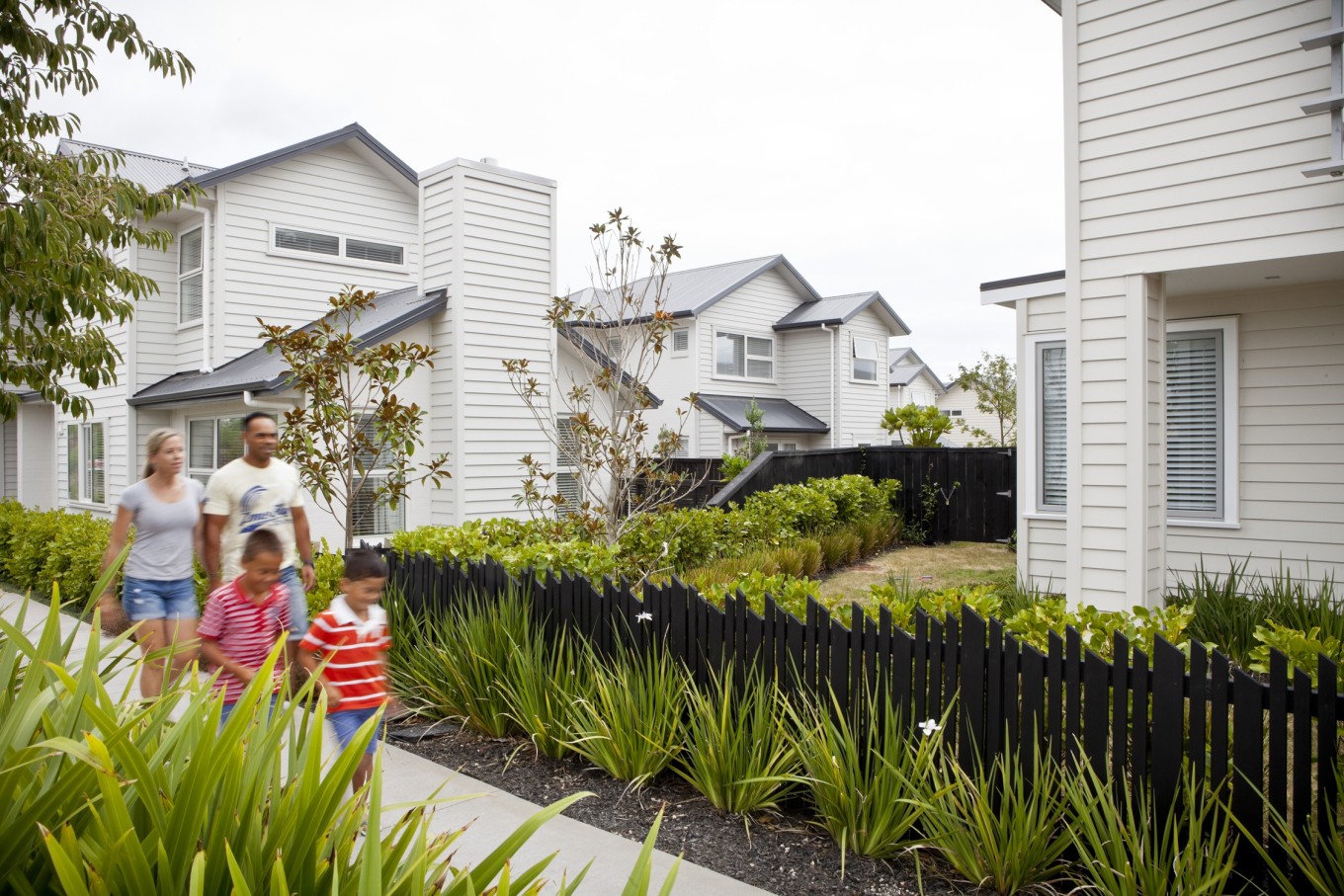
“The planning of Hobsonville Point stands out for me. We have walkable streets, shared laneways, public art and our coastal walkway has become a community anchor. It draws people here,” he says.
The planning Buzz mentions is a recurring theme. Architect Errol Haarhoff was impressed by the area's master-planning, clear urban design guidelines, the consistent quality of housing and the surrounding environment.
Errol says: “We didn’t actively choose Hobsonville Point. It chose us. We came here for a visit on a whim after hearing about the farmers' market and loved the place so much we put a deposit on a house within a week,” he says.
Like Buzz, Errol was drawn to the area's walkability and the presence of social infrastructure. He highlights that early investment in schools, public art, markets, and the coastal walkway helped potential buyers imagine what life would be like in Hobsonville Point.
Errol participated in a National Science Challenge project, which looked at Hobsonville Point as a case study. The study involved interviews with residents.
‘Living at Density in Hobsonville Point, Auckland: Resident Perceptions’ was authored by Errol Haarhoff, Natalie Allen, Patricia Austin, Lee Beattie and Paola Boar in April 2019.
Overwhelmingly, their research demonstrated that satisfaction among residents was high. Respondents highlighted the importance of quality public spaces at Hobsonville Point, which prioritised the wellbeing of residents.

Good development through partnership
Jenny Larking is Head of Growth and Regeneration Delivery in Auckland Council’s newly established Auckland Urban Development Office (AUDO). She is also a resident of Hobsonville Point.
She says the new AUDO is council’s “front door” for partnerships like the one that made Hobsonville Point possible, working with government agencies, iwi, developers, not-for-profit organisations and other partners to deliver smarter, better urban outcomes in Auckland.
She says Hobsonville Point is a shining example for the future of new housing in Tāmaki Makaurau because of its careful master-planning and design.
“The site allowed developers and council to plan new infrastructure, housing, resilience features and amenity all at once, and then to use the area’s uniqueness to get better outcomes. It is always our ambition at Auckland Council, through the Unitary Plan, to enable good development and good design through smart, strategic partnerships.”
Jenny says people have embraced the lifestyle at Hobsonville Point.
“From what I’ve seen, people don’t try and live as they might have lived anywhere else. They enjoy and embrace what’s been created here. Generations can move through different stages in this area – from stand-alone houses to townhouses, duplexes, apartments and even retirement villages.
“And parents of young children have a level of comfort here - 60 to 70 percent of kids walk or cycle to school, a lot higher than the Auckland average. The pathways are wide, roads are safe to cross and we have good pedestrianised infrastructure, encouraging people to get out and about,” Jenny says.
She adds that in new housing development like this Auckland Council and developers build flood resilience in from the start - with rain gardens, bio swales and wetlands protecting people, property and the environment from flooding.
Transport options are also evolving to match people’s needs. The popular ferry service has been expanded to have more sailings and they carry bikes and scooters on board, allowing people to make multi-modal trips.
Multiple bus routes run through the neighbourhood, including the recently improved number 12 service, which connects Henderson and Constellation Station on the Northern Busway via Hobsonville. This service, with double decker electric buses, is one of the most popular in Auckland.
Density done well
Orson Waldock works for Kāinga Ora (and formerly Hobsonville Land Company) as Team Leader Urban Design and is also a long-time resident of Hobsonville Point. In his role at Kāinga Ora, he helped shape the design and delivery of the neighbourhood over six years.
“Within the Kāinga Ora team, this project is colloquially known as the ‘University of Hobsonville Point’. It has enabled us to explore what density done well looks like in a contemporary Auckland context,” Orson says.
“While early housing at Hobsonville Point was more conventional (standalone homes on compact sections), over time we’ve been able to innovate, test and deliver a greater variety of housing forms including terraces, apartments and mixed-use buildings.
“The uplift in density (approximately two to three times greater than conventional suburbs) has come with unique challenges as section sizes have decreased. A large part of my role has been working alongside builder partners and designers to ensure we maintain design quality and liveability.
“My experience of living in Hobsonville Point for 10 years is that the community makes the most of this new kind of neighbourhood. I meet at the local bus stop most mornings at 6am to run with the Early Bird Run Crew. It’s an amazing group of locals who shuffle 5km around the stunning Te Onekiritea Park and Coastal Walkway. The exercise is good, but the company is better. It’s a regular reminder of why we chose to move to Hobsonville Point,” he says.
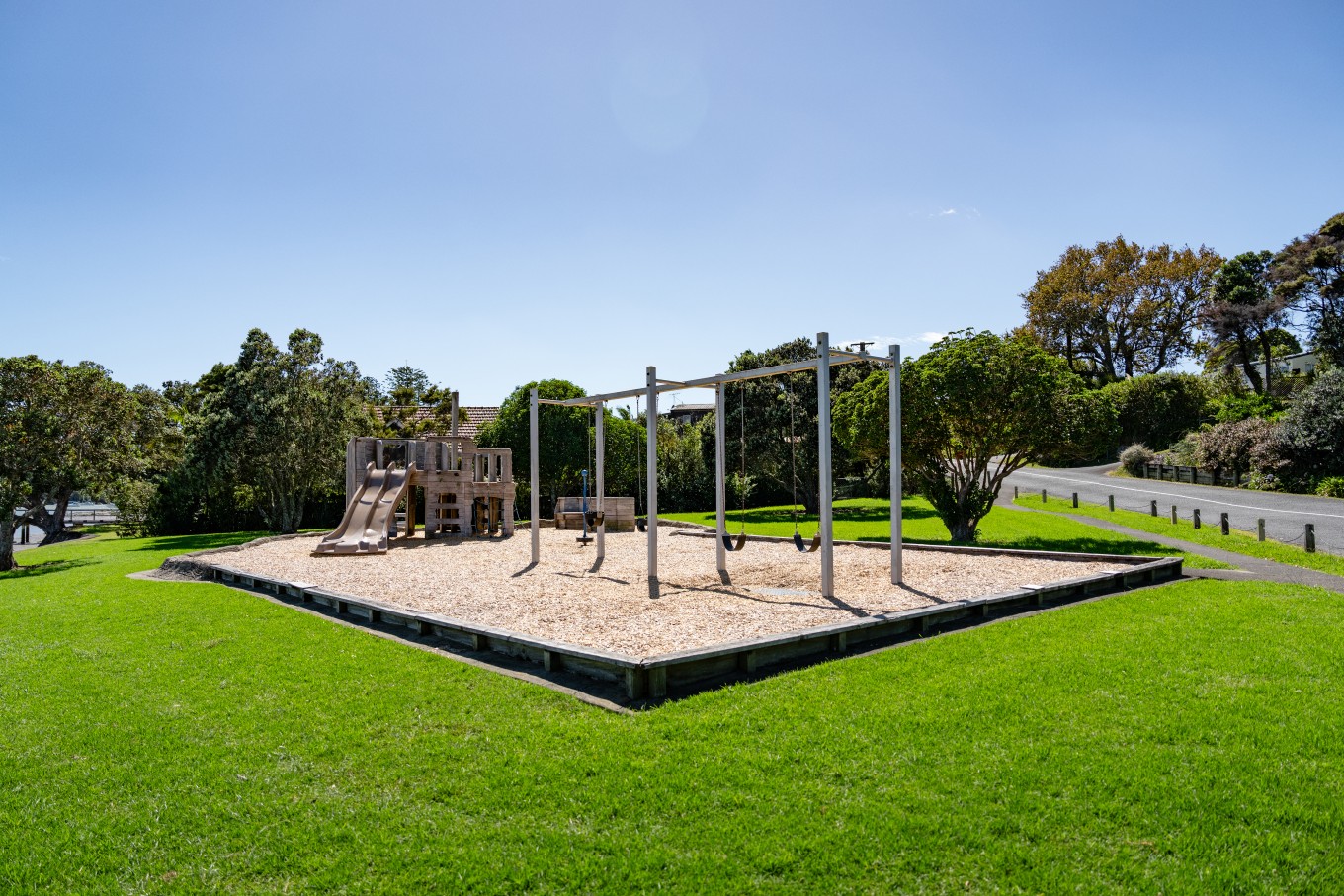
Hobsonville has some fun-tastic playgrounds for the kids to enjoy all year round.
The people of Hobsonville Point are proud of their place. It's a proof-point for a widely-held urban planning premise that a mix of housing options will foster vibrant, inclusive, and connected communities.
Hobsonville Point’s transformation reflects what is possible.