


From today (Wednesday 29 July), Aucklanders will be able to see and experience two new taonga toi (public art), unveiled in one of the city’s busiest public places.
Blessed at a formal dawn ceremony led by Ngāti Whātua Ōrākei earlier in the day, the splendour of these two bronze artworks gleams in the morning light.
When the City Rail Link (CRL) is open, thousands of train passengers will arrive at street level through the north-eastern exit from Te Waihorotiu Station, predicted to be the most well-used train station in New Zealand.
As they pour out of the station, they will witness Wāhine and then walk to Horotiu. These striking artworks create a dialogue - one welcoming and one grounding.
Wāhine depicts a Māori woman performing a karanga (call of welcome). She stands on a low plinth, scaled and oriented to meet the gaze of manuhiri (visitors) as they ascend the ramp from the underground station.
Further along Victoria Street West towards Queen Street stands Horotiu, providing a powerful dual art experience with Wāhine.
Horotiu is cast in bronze as a large-scale tuna kūwharuwharu (longfin eel). For people arriving at the corner of Queen and Victoria Streets, Horotiu descends in a spiral to the footpath which is paved in volcanic basalt, etched by the artists to reflect the stream bed.
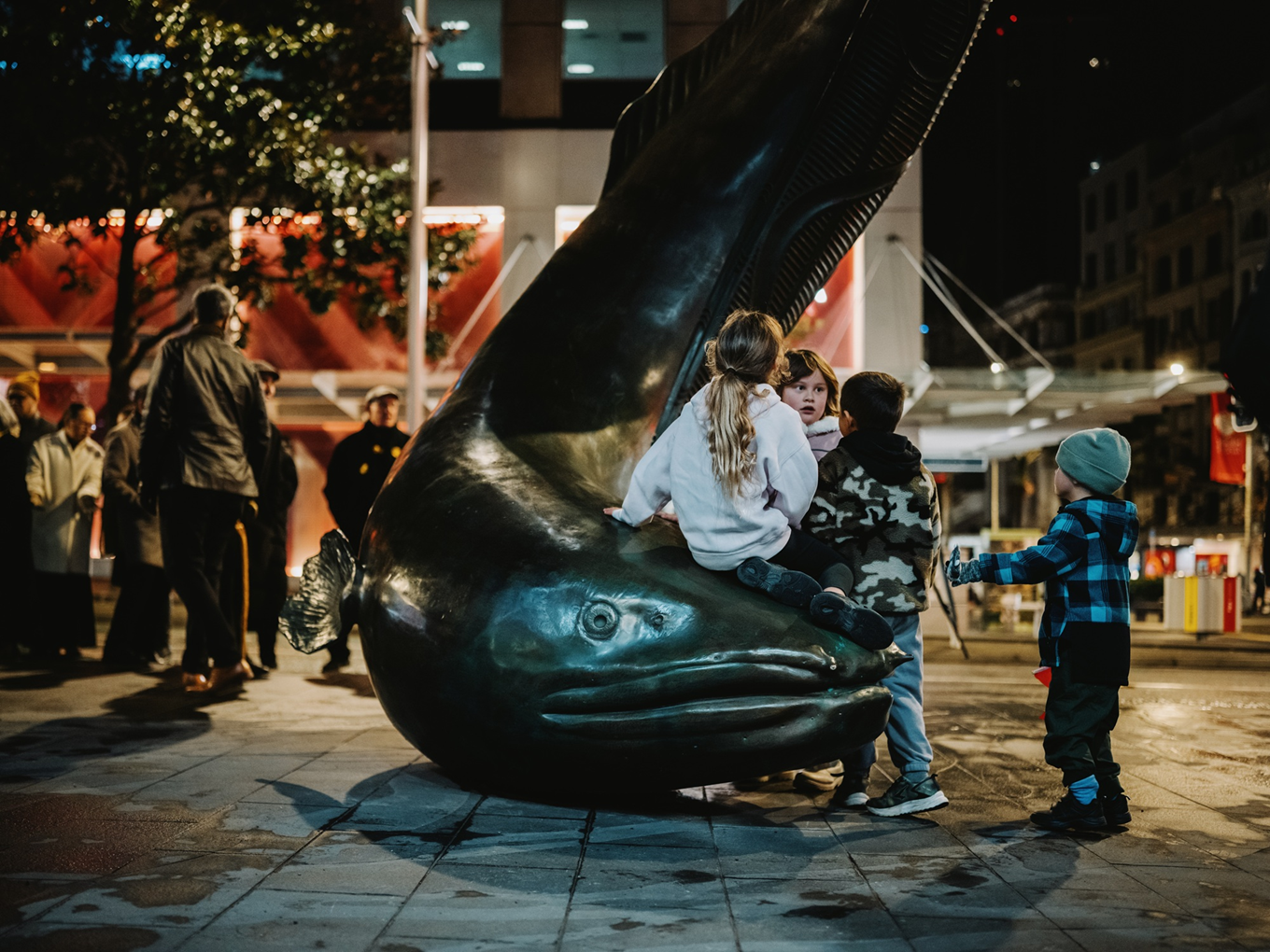
Horotiu with children playing. Photo credit: David St George.
This artwork gives enduring expression to the legendary kaitiaki (guardian) and protector of the Waihorotiu stream, bringing this important narrative into the everyday life of the city.
The context
Centuries ago Māori settlements thrived along the banks of Te Waihorotiu, when this ancestral stream was abundant with fish and plants. The waters of the stream now flow through underground pipes to the Waitematā Harbour, but the stream retains both mana and mauri for Māori.
Deputy Mayor Desley Simpson says these significant pieces of public art beautifully showcase the depth and vibrancy of our indigenous culture, while enriching the fabric of our city centre.
“They honour the stories of our place, elevate our public spaces, and reflect the extraordinary skill and vision of the artists who brought them to life.
“We are proud to see Māori narratives expressed so prominently in midtown, and we congratulate the artists and project team for delivering taonga that will inspire Aucklanders and visitors for generations,” she says.
Auckland Council Head of Arts and Culture Emily Trent is delighted these taonga, crafted by four prominent New Zealand artists, can be enjoyed by passengers using the busiest rail station in the country and by all Aucklanders and visitors for decades to come.
"Whether people encounter these works as part of their daily rhythm or as part of their first trip to our city, they are invited into a richer understanding of place, identity and belonging.
“To me, that is manaakitanga - the hospitality, generosity and care we show for others - welcoming people, and affirming that toi Māori is foundational to the experience of our city," she says.
Together, the works demonstrate how public art can make visible the histories, identities and narratives that have shaped Tāmaki Makaurau for generations.
Funding for both new artworks was provided largely by the city centre targeted rate.
The art
Wāhine is a 3.7 metre bronze sculpture of a Māori woman, created by master carver Arekatera (Katz) Maihi (Ngāti Whātua Ōrākei, Ngāti Whātua ki Kaipara, Tainui, Te Waiohua, Ngāpuhi) and Beronia Scott (Ngāti Whātua Ōrākei).
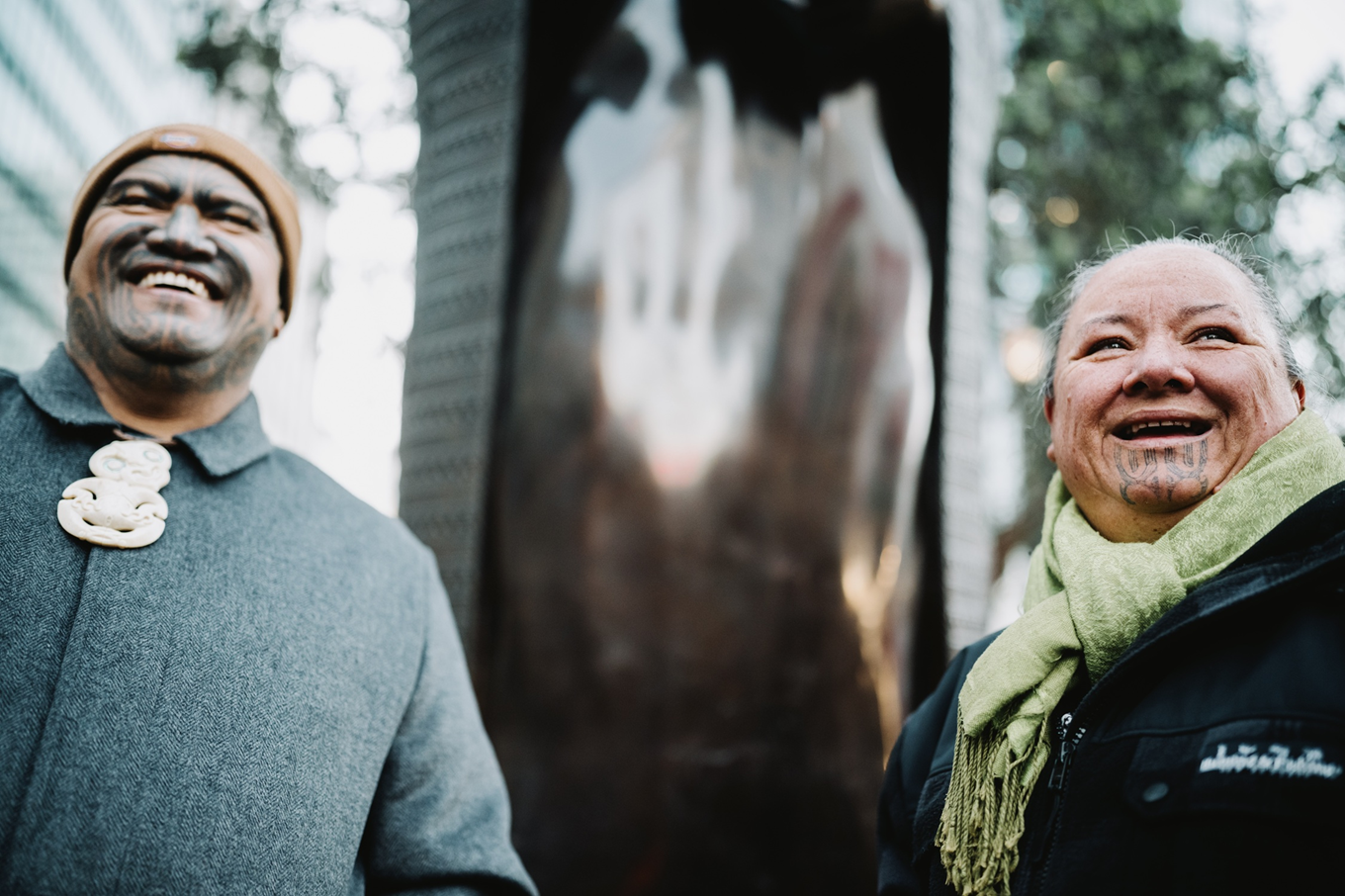
Wāhine artwork with artists Katz Maihi (Left) and Beronia Scott. Photo credit: David St George.
The artists wanted the artwork to be a figurative model of a Māori woman – with the mana and seniority to perform this critical cultural ritual of manaakitanga (welcoming visitors.)
Cast in silicon bronze, contrasting patina finishes distinguish her body, hair, hei tiki (pendant), kawakawa (native leaves) and korowai (cloak). She stands on a 600 mm-high basalt plinth.
Karanga is traditionally performed by women, embodying mana wāhine – the strength and authority of women. Artist Beronia Scott drew on her expertise in raranga (weaving), translating its textures and forms into bronze, to inform the design of the korowai worn by this timeless wāhine figure.
Katz Maihi conceived Wāhine as a contemporary counterpart to the 1960s sculpture A Māori Figure in a Kaitaka Cloak by Molly Macalister, which has graced Auckland’s waterfront for decades.
“Wāhine embodies the offering of a karanga to everyone coming from the underground realm of Te Waihorotiu Station into the light of Te Hā Noa and Victoria Street,” he says.
Horotiu is 7.2-metre-long tuna kūwharuwharu (longfin eel) cast in silicon bronze. This taonga toi was created by artists Chris Bailey (Ngāti Hako, Ngāti Pāoa, Ngāti Porou, Te Aupouri) and Sally Smith.
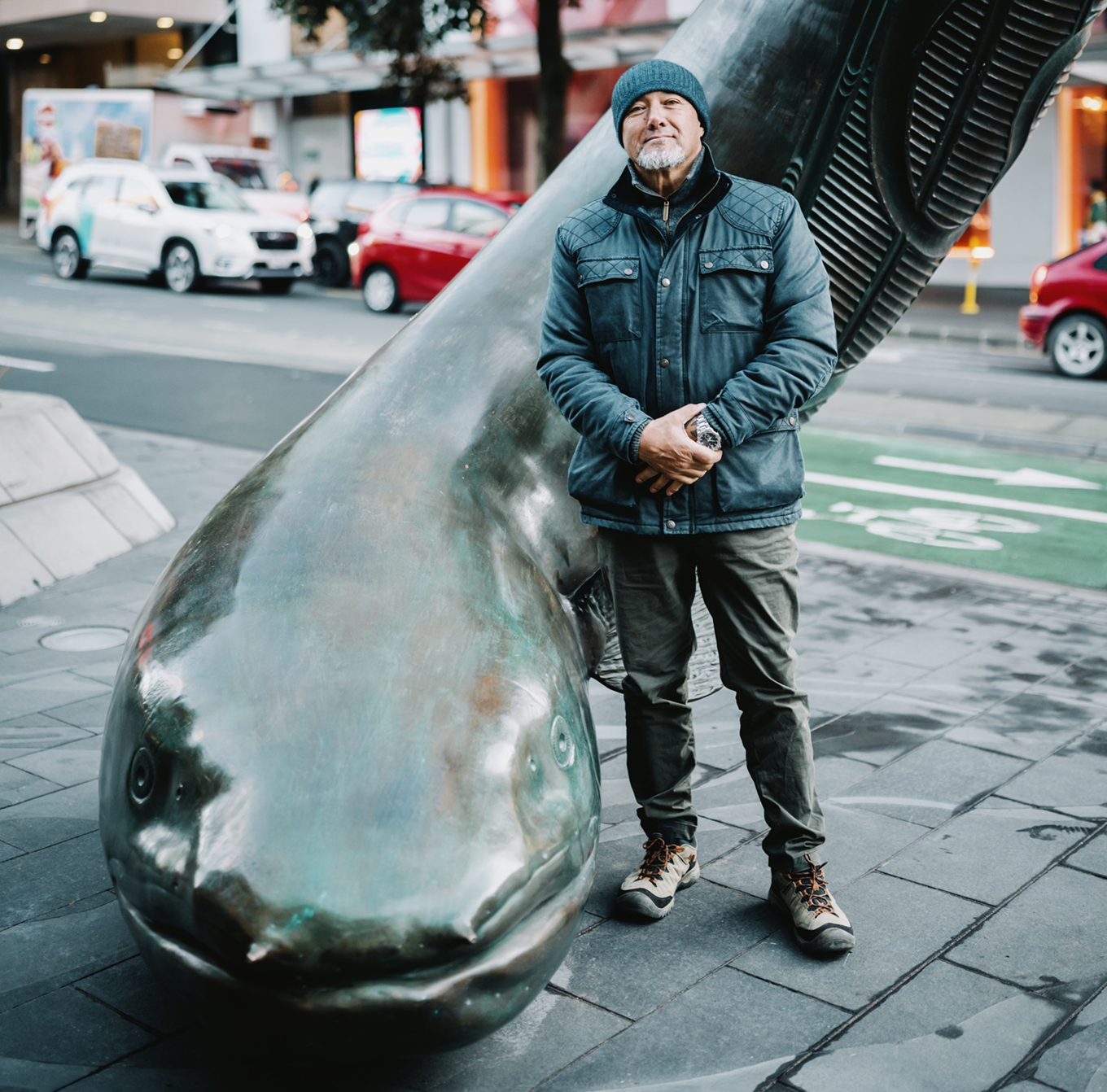
Horotiu with artist Chris Bailey. Photo credit: David St George.
Horotiu is depicted spiralling downward from Puna Kauariki, the celestial spring. Its chin lightly touches the footpath, marking the place where the path of the Waihorotiu Stream is understood to have been diverted by a lava flow following the eruption of Rangipuke (near Albert Park) around 60,000 years ago.
Whakairo (intricately carved patterns) on the belly of the eel tell the story of the remarkable migration of tuna between the rivers of Aotearoa and the deep waters of the Pacific Ocean’s Kermadec Trench, where they breed. Juvenile tuna (eels) return back to the rivers and streams of Aotearoa along the same route to begin the cycle again.
In te ao Māori, tuna are closely associated with Te Ihorangi, the atua of rain, whose life-giving waters replenish the rivers, streams and wetlands on which they depend.
Artist Chris Bailey explains that Horotiu takes many forms for Māori.
“Here we have Horotiu taking the form of the tuna kūwharuwharu, a taonga species for Māori. The eel is seen here descending from the heavens - its spiritual origin. This artwork speaks to the importance of water and rainfall, as we respond to climate change, protect our environment, and ensure water security for future generations.”
“With Horotiu we wanted to give people a chance to pause, explore, take a drink of water from the fountain, and reflect on why this huge tuna is here. It starts the narrative, especially for our tamariki who will be able to interact with the work in a playful way. We wanted to bring our narratives into everyday conversation,” he says.
The place
Auckland Council is committed to ensuring the stories of mana whenua are reflected in the city centre’s urban landscape.
Expressions of te ao Māori (the Māori world) can be seen in planting, language, paving patterns, handrails, drinking fountains, bus shelters, murals, art and design throughout the redeveloped parts of the city centre.
Embedding mana whenua narratives and expressions of te ao Māori was central to the planning of the midtown regeneration, a $133 million upgrade and redesign of the area, announced in 2021. The project is reshaping the area into a vibrant station precinct, ready to welcome the thousands of people who will pass through Te Waihorotiu Station each day when the City Rail Link opens.
Te Hā Noa, the upgrade of Victoria Street, is one of the flagship projects within Auckland’s wider midtown regeneration. The final stage in Victoria Street East is due for completion late 2026.
Throughout the project, Auckland Council Public Art, the council’s Auckland Urban Development Office and Auckland Transport worked closely with a dedicated Te Hā Noa mana whenua working group. Representatives from Ngāi Tai ki Tāmaki, Te Aakitai Waiohua, Ngāti Whātua Ōrākei, Ngaati Whanaunga, Te Patukirikiri, and Ngāti Maru provided cultural leadership, guidance and oversight throughout design and delivery of the project.
CRL stations and tunnels will soon become part of the wider Auckland Transport rapid transit network. Te Waihorotiu Station will offer services on the East West Line and South City Line, connecting to key bus routes with stops right outside the station.
Two other CRL station neighbourhoods in the city centre were completed earlier this year: Waitematā Station neighbourhood and Karanga-a-Hape Station neighbourhood.
The artists
Arekatera Maihi, Katz Maihi as he’s widely known, is a whakairo (carving) and tā moko (traditional tattoo) artist, now based in Whakatāne. His artworks range from the iconic Te Ara I Whiti –The Lightpath in central Auckland which marked its 10th anniversary last year, to the video game ‘Civilization’.
“Art for me came along at a really young age. My grandparents had all these encyclopaedia in the house, but the only book I ever grabbed was the Hirini Moko Mead whakairo book ‘Te Toi Whakairo: The Art of Māori Carving’. I just grabbed that one book, lay on the ground, grabbed the newspaper and started trying to draw.”
Seeing the carving of Ōrākei marae left a lasting impression on the young Katz. “I saw my uncles carving. That was a big thing – encouraging me to follow this artistic route,” he says.
Beronia Scott is lead weaver at Ngāti Whātua Ōrākei - an inspiring leader of mahi toi through her skills of raranga, the art of Māori weaving.
Scott started her journey with the teachings from Alice Pihema, known as ‘Aunty’, and continued learning through Te Wānanga o Aotearoa. With new knowledge, she has continued Aunty Alice's teachings by sharing these traditional practices with others over many years.
Chris Bailey is based on Waiheke Island. He studied Māori material culture at the University of Auckland before becoming a full-time sculptor and carver.
Working largely in stone, bronze and timber, his practice is informed by his Māori heritage as he works to engage the public with Māori concepts and narratives. His works are held in both public and private collections throughout New Zealand and globally.
Sally Smith lives and works on Waiheke Island too. Graduating from Auckland University with a Bachelor of Architecture in 1993, Smith practised architecture until 2010, when she chose to focus solely on her art practice.
Smith has a particular interest in raising awareness of the fragility of our environment, and the role we play as guardians. Smith’s works are also informed by her experience as a mother of European background with children of Māori descent.
While Bailey and Smith have independent art practices they sometimes collaborate on projects that require their various skill-sets, as they have with Horotiu.
The investment
Auckland Council’s investment in new artworks, Horotiu and Wāhine, was $632k for Horotiu with 72.2% funded by the city centre targeted rate, and $744k for Wāhine with 65.5% funded by the city centre targeted rate.
The city centre targeted rate is contributed by city centre businesses and property owners. It funds a programme of urban regeneration and events in the city centre throughout the year. This resource provided by these businesses and property owners is reinvested to benefit that same community directly, while also providing new assets and activations which benefit all Aucklanders and visitors to the city centre.